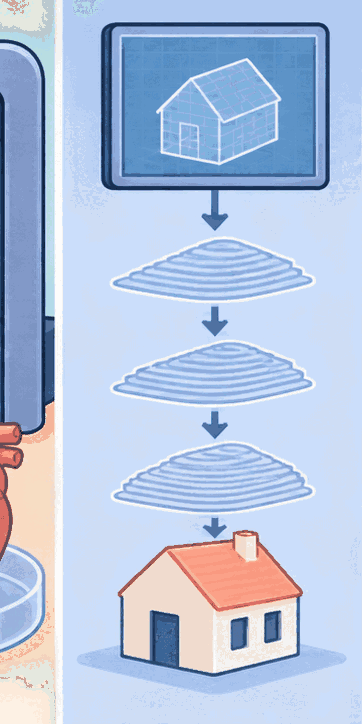
3D printing adds material only where a digital design requires it. a 3D printer turn a digital file into an object depends on laboratories, engineers, suppliers and the physical systems that turn an idea into something reliable and affordable.
Reading confidence0% of the way to explored
The deeper explanation
The answer in detail
The answer is shaped by technical capability, infrastructure, cost, safety and public choices about deployment. It becomes clearer when the immediate event is connected to the institutions and choices behind it.
Why it matters
Additive manufacturing could localise production and personalise medicine while disrupting supply chains and product regulation.
The infrastructure behind a 3D printer turn a digital file into an object
Standards, software, data, energy and specialised equipment determine who can use a 3d printer turn a digital file into an object and whether different systems work together.
Investment and regulation shape the pace: research funding and large customers pay for scale, while safety, privacy or export rules determine where the benefits and risks land.
System lens
What makes this more complicated?
Three layers that help explain what changes the outcome.
Starting conditions
Evidence, available capability and access set the starting position before the technology reaches everyday use.
Limits and trade-offs
Rules, capacity and competing priorities limit which responses are practical, even when several options look possible.
Choices and distribution
The outcome depends on who can change those conditions and how its consequences are shared.
Could we eventually print houses, food and human organs?
Shared background, people, references and other questions for this story collection.
Read the main storyMeet the players
3D printing could revolutionize the production of houses, food, and human organs.
organization
NIST
Standardization and research in additive manufacturing
Wants toto develop standards and guidelines for additive manufacturing to ensure quality and safety.
LeverageInfluences the regulatory framework for 3D printing.
Read profile: NIST
NIST conducts research and develops standards for additive manufacturing, focusing on improving material quality and production processes. Their work aims to facilitate the safe and effective use of 3D printing technologies across various industries, including construction and healthcare.
organization
ISO/ASTM
Development of international standards for additive manufacturing
Wants toto create and maintain standards that ensure the interoperability and quality of additive manufacturing processes.
LeverageSets the benchmarks for quality and safety in 3D printing.
Read profile: ISO/ASTM
ISO/ASTM develops international standards for additive manufacturing, which help ensure consistency and safety in 3D printing practices. Their standards are critical for industries looking to adopt 3D printing technologies for production and prototyping.
organization
NIH
Research in bioprinting and organ printing
Wants toto advance the science of bioprinting for medical applications, including organ transplantation.
LeverageDrives advancements in medical applications of 3D printing.
Read profile: NIH
The NIH conducts extensive research in bioprinting, focusing on the development of technologies to print human organs. Their work aims to address organ shortages and improve transplant outcomes through innovative 3D printing techniques.
company
ICON
Manufacturer of 3D printing technology for construction
Wants toto innovate and produce 3D printers for building homes.
LeverageProvides the technology necessary for 3D printed housing solutions.
Read profile: ICON
ICON develops advanced 3D printing technology specifically for construction, enabling the rapid and cost-effective production of homes. Their innovations aim to address housing shortages by providing a scalable solution for affordable housing.
government
FDA
Regulatory oversight of medical devices and bioprinting
Wants toto ensure that bioprinted organs and medical devices meet safety and efficacy standards.
LeverageEnforces regulations that impact the adoption of bioprinting technologies.
Read profile: FDA
The FDA regulates the use of bioprinting technologies in medicine, ensuring that printed organs and medical devices are safe for public use. Their oversight is crucial in preventing misuse and ensuring compliance with health regulations.
Sources & visual credits
Flags and logos identify the actors; they do not imply endorsement.
Story collection
6 questions to explore
Open a question to read its explainer and follow the linked questions in this collection.
- 01Could we eventually print houses, food and human organs?Featured
- 02You are hereOpen now
- 03Why can 3D printing create shapes that factories cannot?
- 04Can printed houses solve housing shortages?
- 05How close are scientists to printing usable human organs?
- 06Could anyone eventually print dangerous objects at home?
A quick glossary for this collection.
Additive manufacturingBuilding an object by adding material layer by layer.
SlicingTurning a digital model into printable layers.
FeedstockThe material supplied to a manufacturing process.
BioprintingUsing cells and biomaterials to build tissue-like structures.
Digital modelA computer representation of an object’s shape.
PrototypeAn early version built to test an idea.
Sources for the whole story
How we work ↗Sources to start with
These references support the story collection as a whole.
Take the question with you
Visit the shop →Make complex ideas conversation starters.
Explore humorous products inspired by stories such as Could we eventually print houses, food and human organs?.