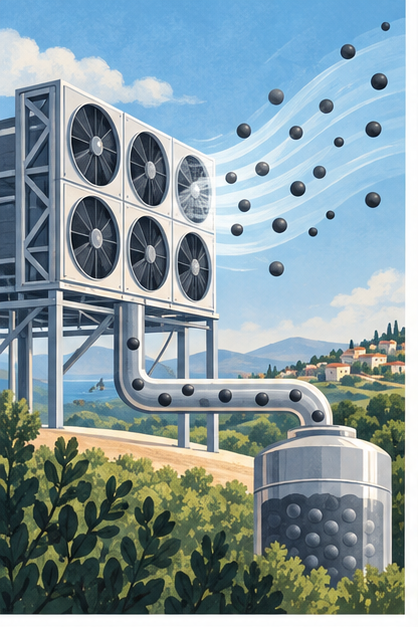
Capture can prevent some emissions from reaching the atmosphere or remove carbon already there. This makes carbon capture depend on land use, weather and the infrastructure that stores and moves the resource.
Reading confidence0% of the way to explored
Complex · 10 min read
The deeper explanation
What is carbon capture? is shaped by the forces, choices and constraints described in this collection.
The immediate chain is specific to Can carbon capture remove enough carbon from the atmosphere? : Capture can prevent some emissions from reaching the atmosphere or remove carbon already there. Storage must remain secure and measurable over long periods. Scale, cost, energy, land and governance limit how much removal can contribute.
The system is constrained by the conditions described in the story. Carbon capture includes several technologies and land practices, each with different costs, energy needs, permanence and scale. Understanding the deeper picture means connecting technical capability with infrastructure, cost, safety, regulation and the choices people make about deployment. The outcome depends on which pressures are strongest, which resources are available and how the people or institutions involved respond.
The situation can change when the relevant actors alter their behaviour, when a key resource becomes scarce or available, or when a rule changes who can act and at what cost.
The consequences extend beyond the immediate question. Carbon capture may help address residual emissions, while its limits make direct emission reductions essential.
A systems view makes the longer mechanism visible: Starting conditions: History, resources and institutional capacity set the starting position before the visible outcome appears. Limits and trade-offs: Rules, capacity and competing priorities limit which responses are practical, even when several options look possible. Choices and distribution: The outcome depends on who can change those conditions and how its consequences are shared.
For Can carbon capture remove enough carbon from the atmosphere?, the practical outcome turns on Starting conditions, Limits and trade-offs, Choices and distribution. Those details determine what each participant can do next and how the result changes over time. The visible outcome is therefore the end of a chain: a decision changes access to a resource, that change alters behaviour, and the new behaviour affects the next decision.
Why it matters
Carbon capture may help address residual emissions, while its limits make direct emission reductions essential.
The wider system behind carbon capture
Farms, cities, households and ecosystems draw on the same resource, so decisions about carbon capture redistribute access, prices and risk between users.
Insurance, public budgets and trade carry the effects beyond the immediate place: a local shortage or adaptation choice can change food prices, health costs and investment elsewhere.
Story collection
6 questions to explore
Open a question to read its explainer and follow the linked questions in this collection.
Meet the players
Carbon capture technologies aim to reduce atmospheric carbon levels.
organization
Intergovernmental Panel on Climate Change (IPCC)
Research and policy guidance
Wants toto provide scientific assessments on climate change and its impacts, including the role of carbon capture.
LeverageInfluences international climate agreements and national policies through scientific assessments.
Read profile: Intergovernmental Panel on Climate Change (IPCC)
The IPCC shapes global climate policy by assessing the science of climate change. Their reports inform governments and organizations about the effectiveness and limitations of carbon capture technologies in mitigating climate change, emphasizing the need for integration with direct emission reductions.
organization
International Energy Agency (IEA)
Energy policy analysis
Wants toto promote policies that enhance the reliability, affordability, and sustainability of energy.
LeverageShapes energy policy and investment through comprehensive analysis and recommendations.
Read profile: International Energy Agency (IEA)
The IEA analyzes the role of carbon capture, utilization, and storage (CCUS) in energy transitions. Their reports provide insights into the energy needs and costs associated with carbon capture technologies, influencing energy policy and investment decisions globally.
organization
United Nations Environment Programme (UNEP)
Environmental advocacy and policy
Wants toto encourage sustainable development through sound environmental practices.
LeverageInfluences global environmental policies and initiatives through advocacy and reporting.
Read profile: United Nations Environment Programme (UNEP)
UNEP addresses global environmental issues, including climate change. Their Emissions Gap Report highlights the necessity of carbon capture as part of a broader strategy to reduce greenhouse gas emissions, stressing the importance of secure and measurable carbon storage.
company
Carbon Capture Technology Developers
Innovation and implementation of carbon capture technologies
Wants toto develop and commercialize technologies that capture carbon emissions from various sources.
LeverageDrive innovation and deployment of carbon capture solutions, impacting industry practices and emissions reduction efforts.
Read profile: Carbon Capture Technology Developers
Companies specializing in carbon capture technologies are crucial for advancing methods that can effectively reduce atmospheric carbon. They face challenges related to cost, energy requirements, and scalability, which influence their ability to implement solutions across industries.
group
Fossil Fuel Industry
Major source of carbon emissions
Wants toto maintain energy production while addressing environmental regulations.
LeverageInfluences the adoption of carbon capture technologies based on economic viability and regulatory pressures.
Read profile: Fossil Fuel Industry
The fossil fuel industry is a significant contributor to carbon emissions and faces pressure to adopt carbon capture technologies. Their decisions on implementing these technologies can either support or hinder global efforts to reduce atmospheric carbon levels, depending on their commitment to sustainable practices.
Sources & visual credits
Flags and logos identify the actors; they do not imply endorsement.
System lens
What makes this more complicated?
Three layers that help explain what changes the outcome.
Starting conditions
History, resources and institutional capacity set the starting position before the visible outcome appears.
Limits and trade-offs
Rules, capacity and competing priorities limit which responses are practical, even when several options look possible.
Choices and distribution
The outcome depends on who can change those conditions and how its consequences are shared.
What happens next?
Possible paths from here
Explore the topic
Try a complex prompt
Use this question to continue the explanation at the depth you selected.
Analyse this story as a connected technical and social system. Cover the underlying mechanism, infrastructure, maturity, safety, economics, regulation, access, unintended consequences and the largest sources of uncertainty.
10 essential words
Carbon captureCollecting carbon dioxide before or after it reaches the atmosphere.
Carbon removalTaking carbon dioxide out of the atmosphere and storing it.
Direct air captureUsing equipment to extract carbon dioxide from ambient air.
Geological storageKeeping carbon dioxide in deep rock formations.
MineralisationTurning carbon dioxide into stable mineral forms.
Residual emissionsEmissions that remain after other reductions.
PermanenceThe duration for which removed carbon stays stored.
AdditionalityThe benefit that would not occur without an intervention.
VerificationChecking whether a claimed reduction or removal occurred.
Moral hazardA risk that protection encourages more risky behaviour.
Editorial transparency
What is established, interpreted and still open?
The sources establish how physical conditions, exposure and adaptation shape the outcome.
Climate, ecosystems and local conditions shape the outcome.
The explanation connects the immediate question to the institutions and choices around it.
What happens next will depend on adaptation, land-use choices and the pace of environmental change.
Evidence behind the explanation
How we work ↗Sources to start with
These references anchor the key facts and give you a path to explore further.
One quick check, then keep exploring.
Question 1 of 3
What is carbon capture?
Take the question with you
Visit the shop →Make complex ideas conversation starters.
Explore humorous products inspired by stories such as Can carbon capture remove enough carbon from the atmosphere?.
Understand the next story
One clear briefing, every week.
Three topics worth understanding, without the noise.
Next explanation
Explore next →