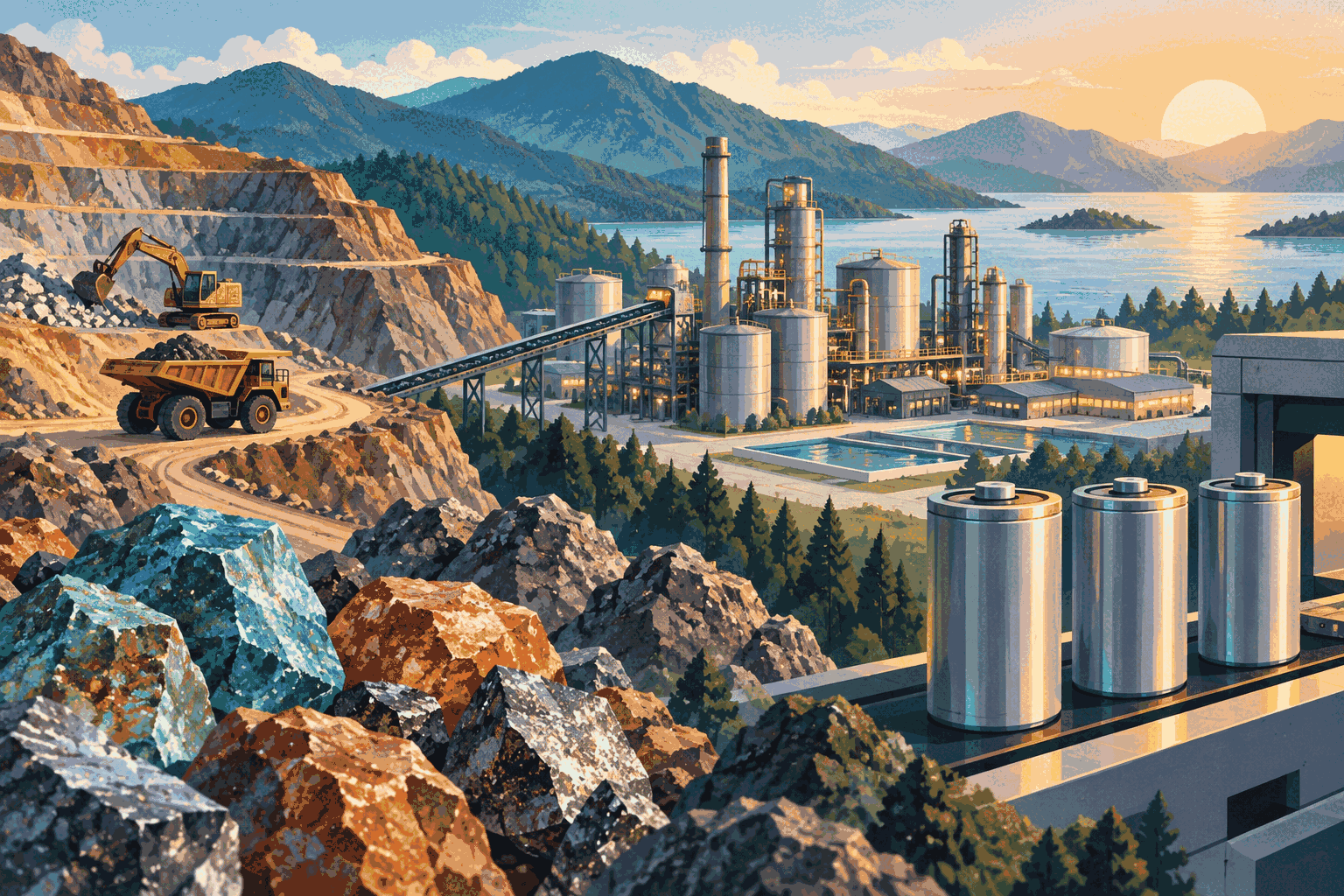
A supplier gains bargaining power when buyers depend on an input that is important and hard to replace. That leverage may come from mining, refining or processing capacity. It has limits: high prices and restrictions encourage alternatives, while suppliers also depend on customers and investment. mineral-rich countries capture more of the benefits is negotiated by governments, organised groups and populations with different security, economic and political constraints.
Reading confidence0% of the way to explored
The deeper explanation
The answer in detail
They can negotiate transparent contracts, collect revenues effectively and invest in skills, infrastructure and local businesses. Processing locally can add value when commercially viable, but requires energy, capital and safeguards. Community participation and environmental standards help determine whether extraction improves livelihoods or leaves lasting costs.
Why it matters
Mineral supply influences the cost and availability of electric vehicles, grids and electronics. For producing communities, the central question is whether jobs and public revenue outweigh social and environmental costs.
The power network behind mineral-rich countries capture more of the benefits
Alliances, trade routes, finance and information flows change the leverage available to each actor, so a local move can alter choices far beyond the original dispute.
Domestic politics and public budgets set the room for manoeuvre: leaders must convert external pressure into policies that people, institutions and markets will bear.
System lens
What makes this more complicated?
Three layers that help explain what changes the outcome.
Starting conditions
Earlier decisions, alliances and unequal leverage set the starting position before the visible dispute unfolds.
Limits and trade-offs
Rules, capacity and competing priorities limit which responses are practical, even when several options look possible.
Choices and distribution
The outcome depends on who can change those conditions and how its consequences are shared.
Can control of critical minerals become political power?
Shared background, people, references and other questions for this story collection.
Read the main storyMeet the players
Control of critical minerals can translate into significant political power.
organization
International Energy Agency
Research and analysis on critical minerals
Wants toto provide insights and forecasts on the supply and demand of critical minerals, influencing policy and investment decisions.
LeverageThe IEA's reports can shape international policies and investment strategies, making it a key player in the geopolitics of critical minerals.
Read profile: International Energy Agency
The International Energy Agency (IEA) analyzes global trends in critical minerals. By publishing reports, the IEA informs governments and industries about the importance of these minerals for energy transition technologies. Their research helps identify potential supply risks and opportunities for investment in mining and processing.
organization
World Bank
Support for extractive industries and economic development
Wants toto promote sustainable development in mineral-rich countries through effective management of resources.
LeverageBy influencing policy and funding projects, the World Bank can help countries maximize the benefits of their mineral resources, impacting global supply chains.
Read profile: World Bank
The World Bank provides financial and technical assistance to developing countries, focusing on sustainable practices in the extractive industries. Their work aims to ensure that mineral wealth translates into economic benefits for local communities, emphasizing transparency and local capacity building.
government
Mineral-rich countries
Suppliers of critical minerals
Wants toto negotiate favorable contracts and maximize economic benefits from mineral extraction.
LeverageTheir control over mineral resources allows these countries to influence global supply chains and pricing, impacting manufacturers and consumers worldwide.
Read profile: Mineral-rich countries
Countries rich in critical minerals can leverage their resources for economic and political gain. By negotiating transparent contracts and investing in local infrastructure, these countries can enhance their bargaining power in the global market. However, they face challenges in ensuring that extraction benefits local communities and adheres to environmental standards.
company
Tesla, Inc.
End-user of critical minerals for battery production
Wants toto secure a stable supply of critical minerals for electric vehicle production.
LeverageTesla can influence demand for critical minerals and pressure suppliers for better terms, impacting the overall market dynamics.
Read profile: Tesla, Inc.
Tesla relies on critical minerals for the production of batteries used in electric vehicles. Their dependence on these materials gives them a vested interest in securing stable and cost-effective supply chains. Tesla may seek to diversify sources or invest in recycling to mitigate risks associated with supply disruptions.
company
Umicore
Recycling and processing of critical minerals
Wants toto recover and process critical minerals from used products.
LeverageBy increasing the availability of recycled materials, Umicore can influence market dynamics and reduce pressure on virgin mineral supplies.
Read profile: Umicore
Umicore focuses on recovering valuable materials from end-of-life products, contributing to a circular economy. Their operations can reduce dependence on primary mineral sources and help stabilize supply chains. However, they face challenges in establishing efficient collection and processing systems.
Sources & visual credits
Flags and logos identify the actors; they do not imply endorsement.
Story collection
6 questions to explore
Open a question to read its explainer and follow the linked questions in this collection.
A quick glossary for this collection.
Critical mineralA material assessed as important and exposed to supply risk.
OreRock containing material that may be economically extracted.
RefiningProcessing material to the purity or form needed for use.
ConcentrationA large share of supply located in few producers or places.
SubstitutionUsing a different material or technology.
StockpileMaterial stored for future use or disruption.
Sources for the whole story
How we work ↗Sources to start with
These references support the story collection as a whole.
Take the question with you
Visit the shop →Make complex ideas conversation starters.
Explore humorous products inspired by stories such as Can control of critical minerals become political power?.