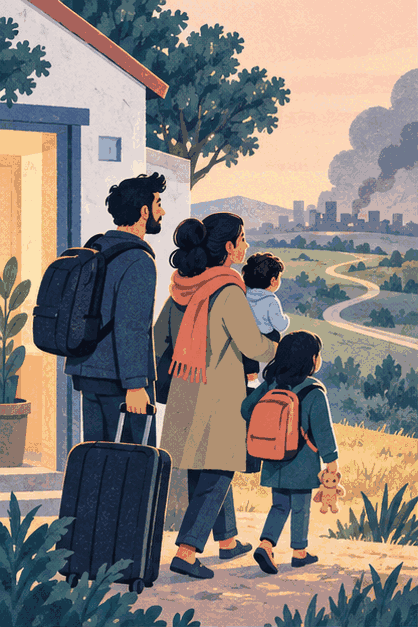
People leave when danger, lost income or environmental pressure outweighs the cost and risk of moving; those forces rarely act alone.
Reading confidence0% of the way to explored
Complex · 10 min read
The deeper explanation
The answer is shaped by institutions, social conditions, unequal exposure and the choices available to different groups. It becomes clearer when the immediate event is connected to the institutions and choices behind it.
The immediate chain is specific to Why do people leave everything behind? : Most people who move remain within their own country or region. A journey can be voluntary, forced—or somewhere between. Legal status never describes a person’s worth.
The system is constrained by the conditions described in the story. Migration emerges from interacting pressures and opportunities. Personal resources, social networks, border rules and labour demand shape who can move, which routes are available and whether movement is temporary or lasting. The outcome depends on which pressures are strongest, which resources are available and how the people or institutions involved respond.
The situation can change when the relevant actors alter their behaviour, when a key resource becomes scarce or available, or when a rule changes who can act and at what cost.
The consequences extend beyond the immediate question. Migration affects workplaces, schools, housing and public services, making good planning essential.
A systems view makes the longer mechanism visible: Starting conditions: History, resources and institutional capacity set the starting position before the visible outcome appears. Limits and trade-offs: Rules, capacity and competing priorities limit which responses are practical, even when several options look possible. Choices and distribution: The outcome depends on who can change those conditions and how its consequences are shared.
For Why do people leave everything behind?, the practical outcome turns on Starting conditions, Limits and trade-offs, Choices and distribution. Those details determine what each participant can do next and how the result changes over time. The visible outcome is therefore the end of a chain: a decision changes access to a resource, that change alters behaviour, and the new behaviour affects the next decision.
Why it matters
Migration affects workplaces, schools, housing and public services, making good planning essential.
Migration is shaped by security, work and networks
Family, language, money and earlier migrants create routes that make one destination more reachable than another, even when borders are tightening.
Wars, labour demand, visa rules and remittances connect origin and destination economies, so migration is also a system of employers, states and households.
Story collection
6 questions to explore
Open a question to read its explainer and follow the linked questions in this collection.
Meet the players
The people and organisations that can change what happens in “Why do people leave everything behind?”. Each card explains a goal, a source of leverage and a constraint.
Government
Public authorities
Officials and institutions responsible for the issue
Wants tomanage the problem while retaining legitimacy
LeverageRules, budgets and enforcement.
Read profile: Public authorities
Public authorities shape the issue through laws, spending, services and enforcement. Their decisions determine which options are available to people and organisations.
Evidence, budgets, competing interests and public trust limit their room to act.
What to watchWatch the decisions, resources or constraints that can materially change this actor’s position.
Sources: [1]
Organisations
Organisations working on immigration
Institutions and groups with practical responsibility
Wants todeliver results within their resources
LeverageImplementation, access and specialist capacity.
Read profile: Organisations working on immigration
The organisations closest to the issue turn policy into decisions, services and everyday practice. Their actions determine whether plans work outside official statements.
Staff, funding, coordination and local conditions constrain them.
What to watchWatch the decisions, resources or constraints that can materially change this actor’s position.
Sources: [1]
Companies
Businesses and employers
Companies affected by and shaping the outcome
Wants tokeep operating while responding to demand and rules
LeverageInvestment, jobs, prices and supply.
Read profile: Businesses and employers
Businesses react to the incentives created by the issue: they change prices, products, investment or hiring. Those choices affect households and public authorities.
Finance, competition, supply and regulation limit their options.
What to watchWatch the decisions, resources or constraints that can materially change this actor’s position.
Sources: [1]
Community
Households and workers
People experiencing the issue directly
Wants toprotect income, health and choice
LeverageDemand, labour and public pressure.
Read profile: Households and workers
Households experience the issue through work, costs, services and everyday decisions. Their collective behaviour changes demand and creates political pressure.
Income, geography, information and unequal access to alternatives shape how much they can adapt.
What to watchWatch the decisions, resources or constraints that can materially change this actor’s position.
Sources: [1]
Scientific community
Researchers and independent experts
People producing evidence used by decision-makers
Wants toimprove understanding of what works
LeverageEvidence, measurement and explanation.
Read profile: Researchers and independent experts
Researchers and experts make the mechanisms behind the issue visible through data, experiments, monitoring and comparison. Their findings can change policy and expectations.
Evidence may be incomplete, contested or slower than the decisions it is meant to inform.
What to watchWatch the decisions, resources or constraints that can materially change this actor’s position.
Sources: [1]
Decisions travel between them
Public authoritiesOrganisations working on immigrationPublic authorities and Organisations working on immigration shape the outcome through the decisions and limits described in this story.
Public authoritiesBusinesses and employersPublic authorities and Businesses and employers shape the outcome through the decisions and limits described in this story.
Public authoritiesHouseholds and workersPublic authorities and Households and workers shape the outcome through the decisions and limits described in this story.
Public authoritiesResearchers and independent expertsPublic authorities and Researchers and independent experts shape the outcome through the decisions and limits described in this story.
Sources & visual credits
Flags and logos identify the actors; they do not imply endorsement.
System lens
What makes this more complicated?
Three layers that help explain what changes the outcome.
Starting conditions
History, resources and institutional capacity set the starting position before the visible outcome appears.
Limits and trade-offs
Rules, capacity and competing priorities limit which responses are practical, even when several options look possible.
Choices and distribution
The outcome depends on who can change those conditions and how its consequences are shared.
What happens next?
Possible paths from here
Explore the topic
Try a complex prompt
Use this question to continue the explanation at the depth you selected.
Analyse migration as a dynamic system shaped by conflict, climate, labour demand, demographics, social networks, border policy and personal resources. Include feedback loops, policy trade-offs, unintended consequences and limits in the available data.
10 essential words
MigrantA broad term for someone who moves from their usual home.
RefugeeA person protected after fleeing persecution or serious threats.
AsylumProtection requested in another country through a legal process.
DisplacementBeing forced to leave home because of danger or disaster.
Internally displaced personSomeone forced from home who remains inside their country.
Host countryA country where displaced people or migrants settle.
BorderThe recognised line separating two countries or territories.
VisaOfficial permission to enter or remain in a country.
IntegrationThe process of taking part in a new community and society.
RemittanceMoney a migrant sends to family or others in another country.
Editorial transparency
What is established, interpreted and still open?
The sources establish how institutions, unequal access and lived conditions shape the outcome.
Personal circumstances, rules and local capacity shape the result.
The explanation connects the immediate question to the institutions and choices around it.
What happens next will depend on how institutions, communities and people respond to changing conditions.
Evidence behind the explanation
How we work ↗Sources to start with
These references anchor the key facts and give you a path to explore further.
One quick check, then keep exploring.
Question 1 of 3
Why do people leave everything behind?
Take the question with you
Visit the shop →Make complex ideas conversation starters.
Explore humorous products inspired by stories such as Why do people leave everything behind?.
Understand the next story
One clear briefing, every week.
Three topics worth understanding, without the noise.
Next explanation
Explore next →