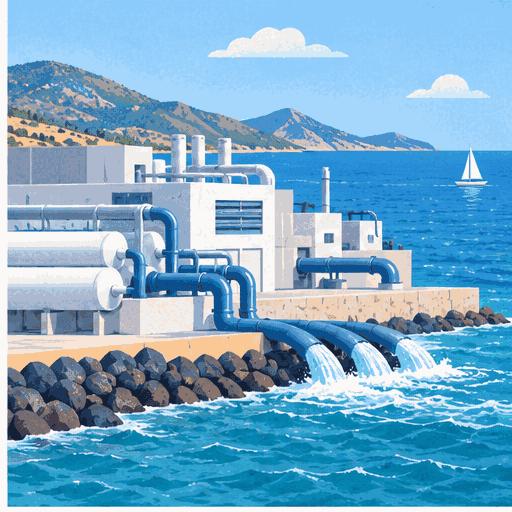
Desalination can make seawater usable near coasts, but it requires reliable electricity and expensive plants, membranes and maintenance.
Reading confidence0% of the way to explored
The deeper explanation
The answer in detail
Desalination adds a source that does not rely on rainfall, but it has operating limits. Reverse osmosis uses high-pressure pumps and electricity; membranes require cleaning and replacement; and concentrated brine must be diluted and discharged without harming coastal ecosystems. A coastal plant may protect households and industry near the shore, but moving large volumes inland requires costly pipelines and additional pumping. Desalination is therefore most useful alongside reservoirs, groundwater management, leak repairs and demand controls, so a power failure or plant outage does not remove a city’s only source.
Why it matters
A desalination plant can reduce dependence on rainfall near the coast, but electricity costs, plant outages, brine disposal and inland pipelines limit how much water it can supply. Households may face rationing, farmers lose irrigation during crop growth, and rivers receive less water for ecosystems and downstream communities.
Desalination trades water scarcity for energy and waste
The concentrated brine must be discharged or managed; its local effects depend on currents, depth and the design of the outfall.
A new supply does not automatically reduce demand: cities may keep approving water-intensive farms, lawns or industries unless prices and rules change too.
System lens
What makes this more complicated?
Three layers that help explain what changes the outcome.
Starting point
Pumps bring seawater into the facility while screens protect equipment and marine life.
What limits access
Reverse osmosis uses pressure and electricity to separate freshwater from dissolved salts.
Where the pressure lands
Pipes and storage connect the new source to homes, farms and industry.
How can a country surrounded by water run dry?
Shared background, people, references and other questions for this story collection.
Read the main storyMeet the players
The people and organisations that can change what happens in “How can a country surrounded by water run dry?”. Each card explains a goal, a source of leverage and a constraint.
Government
National and local governments
Authorities setting climate, land and infrastructure policy
Wants toreduce exposure without unmanageable costs
LeveragePlanning, spending and rules.
Read profile: National and local governments
Governments decide standards, public investment and emergency planning that determine how the issue affects places and people. Their choices shape both exposure and the ability to adapt.
Budgets, elections, competing interests and the physical pace of change limit their options.
What to watchWatch the decisions, resources or constraints that can materially change this actor’s position.
Sources: [1]
Community
Communities living with the change
Residents, farmers and local organisations facing the consequences
Wants tokeep homes, livelihoods and services functioning
LeverageLocal knowledge, adaptation and political pressure.
Read profile: Communities living with the change
Residents, farmers, workers and local groups experience the issue through health, income, food, water or housing. They often see risks first and organise practical responses.
Their ability to adapt depends on resources, insurance, public services and whether relocation is possible.
What to watchWatch the decisions, resources or constraints that can materially change this actor’s position.
Sources: [1]
Operators
Infrastructure and utility operators
Organisations managing essential networks
Wants tokeep energy, water and transport reliable
LeverageMaintenance, investment and service continuity.
Read profile: Infrastructure and utility operators
Utilities and infrastructure operators turn environmental conditions into everyday reliability: outages, water restrictions, transport disruption or rising costs.
They can invest and maintain systems, but face long planning horizons, regulation and scarce capital.
What to watchWatch the decisions, resources or constraints that can materially change this actor’s position.
Sources: [1]
Scientific community
Climate and environmental scientists
Researchers measuring change and risk
Wants toimprove evidence for decisions
LeverageEvidence, forecasts and risk assessment.
Read profile: Climate and environmental scientists
Scientists measure the physical processes behind the issue, test forecasts and identify uncertainty. Their work helps planners distinguish a temporary event from a longer shift.
Measurements take time and cannot decide how societies should divide costs.
What to watchWatch the decisions, resources or constraints that can materially change this actor’s position.
Sources: [1]
Financial institutions
Insurers and lenders
Financial institutions pricing exposure
Wants tomanage physical risk without insolvency
LeverageRisk pricing, coverage and capital.
Read profile: Insurers and lenders
Insurers and lenders convert physical risk into premiums, loan terms and investment decisions. When losses rise, coverage can become expensive or unavailable, changing where people build and invest.
They depend on data, regulation and their own ability to absorb large losses.
What to watchWatch the decisions, resources or constraints that can materially change this actor’s position.
Sources: [1]
Decisions travel between them
National and local governmentsCommunities living with the changeNational and local governments and Communities living with the change shape the outcome through the decisions and limits described in this story.
National and local governmentsInfrastructure and utility operatorsNational and local governments and Infrastructure and utility operators shape the outcome through the decisions and limits described in this story.
National and local governmentsClimate and environmental scientistsNational and local governments and Climate and environmental scientists shape the outcome through the decisions and limits described in this story.
National and local governmentsInsurers and lendersNational and local governments and Insurers and lenders shape the outcome through the decisions and limits described in this story.
Sources & visual credits
Flags and logos identify the actors; they do not imply endorsement.
Story collection
6 questions to explore
Open a question to read its explainer and follow the linked questions in this collection.
A quick glossary for this collection.
AquiferAn underground layer of rock or soil that stores water.
DroughtA long period with unusually little water available.
Water stressWhen demand is high compared with accessible supply.
ReservoirA lake or structure used to store water for later use.
GroundwaterWater held below the ground in soil and rock.
WatershedThe land area that drains rain into one river or lake.
Sources for the whole story
How we work ↗Sources to start with
These references support the story collection as a whole.
Take the question with you
Visit the shop →Make complex ideas conversation starters.
Explore humorous products inspired by stories such as How can a country surrounded by water run dry?.