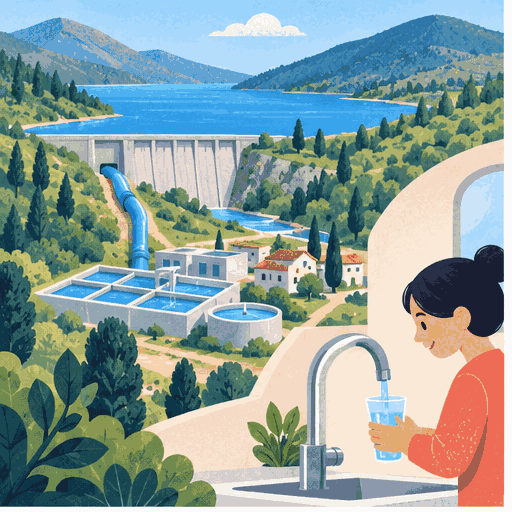
Water travels through a chain of reservoirs, treatment plants, pipes and pumps; a failure in any link can interrupt supply even when the source still contains water.
Reading confidence0% of the way to explored
The deeper explanation
The answer in detail
Rainfall or snowmelt is stored in a reservoir or collected underground in an aquifer. Treatment plants remove sediment and microbes, operators test water quality, and pumps move the treated supply through mains and service pipes. A neighbourhood can lose water even when a reservoir is full: a broken main, power failure or contamination alert can force a utility to stop delivery. During drought, utilities may switch sources or blend reservoir and groundwater supplies, but rivers depend on current rainfall, reservoirs lose water to evaporation and aquifers refill slowly. Repairing leaks can increase delivered supply without withdrawing more from rivers or wells.
Why it matters
A broken main or power outage can interrupt tap water even when a reservoir still contains water. Treatment and distribution determine whether raw freshwater becomes a reliable household supply. Households may face rationing, farmers lose irrigation during crop growth, and rivers receive less water for ecosystems and downstream communities.
A tap depends on infrastructure and institutions
Utilities must pay for maintenance and treatment while keeping bills affordable, creating a permanent tension between reliability, investment and access.
Land use upstream affects the tap downstream: farming chemicals, urban runoff and drought change the cost and quality of treatment.
System lens
What makes this more complicated?
Three layers that help explain what changes the outcome.
Reliability
A city needs enough stored and treated water for dry weeks, maintenance and sudden demand—not only an average annual supply.
Infrastructure
Leaks, power failures and ageing treatment works can turn a plentiful source into an unreliable service.
Access
The same network can serve households differently when prices, geography or interruptions make water harder to reach.
How can a country surrounded by water run dry?
Shared background, people, references and other questions for this story collection.
Read the main storyMeet the players
The people and organisations that can change what happens in “How can a country surrounded by water run dry?”. Each card explains a goal, a source of leverage and a constraint.
Government
National and local governments
Authorities setting climate, land and infrastructure policy
Wants toreduce exposure without unmanageable costs
LeveragePlanning, spending and rules.
Read profile: National and local governments
Governments decide standards, public investment and emergency planning that determine how the issue affects places and people. Their choices shape both exposure and the ability to adapt.
Budgets, elections, competing interests and the physical pace of change limit their options.
What to watchWatch the decisions, resources or constraints that can materially change this actor’s position.
Sources: [1]
Community
Communities living with the change
Residents, farmers and local organisations facing the consequences
Wants tokeep homes, livelihoods and services functioning
LeverageLocal knowledge, adaptation and political pressure.
Read profile: Communities living with the change
Residents, farmers, workers and local groups experience the issue through health, income, food, water or housing. They often see risks first and organise practical responses.
Their ability to adapt depends on resources, insurance, public services and whether relocation is possible.
What to watchWatch the decisions, resources or constraints that can materially change this actor’s position.
Sources: [1]
Operators
Infrastructure and utility operators
Organisations managing essential networks
Wants tokeep energy, water and transport reliable
LeverageMaintenance, investment and service continuity.
Read profile: Infrastructure and utility operators
Utilities and infrastructure operators turn environmental conditions into everyday reliability: outages, water restrictions, transport disruption or rising costs.
They can invest and maintain systems, but face long planning horizons, regulation and scarce capital.
What to watchWatch the decisions, resources or constraints that can materially change this actor’s position.
Sources: [1]
Scientific community
Climate and environmental scientists
Researchers measuring change and risk
Wants toimprove evidence for decisions
LeverageEvidence, forecasts and risk assessment.
Read profile: Climate and environmental scientists
Scientists measure the physical processes behind the issue, test forecasts and identify uncertainty. Their work helps planners distinguish a temporary event from a longer shift.
Measurements take time and cannot decide how societies should divide costs.
What to watchWatch the decisions, resources or constraints that can materially change this actor’s position.
Sources: [1]
Financial institutions
Insurers and lenders
Financial institutions pricing exposure
Wants tomanage physical risk without insolvency
LeverageRisk pricing, coverage and capital.
Read profile: Insurers and lenders
Insurers and lenders convert physical risk into premiums, loan terms and investment decisions. When losses rise, coverage can become expensive or unavailable, changing where people build and invest.
They depend on data, regulation and their own ability to absorb large losses.
What to watchWatch the decisions, resources or constraints that can materially change this actor’s position.
Sources: [1]
Decisions travel between them
National and local governmentsCommunities living with the changeNational and local governments and Communities living with the change shape the outcome through the decisions and limits described in this story.
National and local governmentsInfrastructure and utility operatorsNational and local governments and Infrastructure and utility operators shape the outcome through the decisions and limits described in this story.
National and local governmentsClimate and environmental scientistsNational and local governments and Climate and environmental scientists shape the outcome through the decisions and limits described in this story.
National and local governmentsInsurers and lendersNational and local governments and Insurers and lenders shape the outcome through the decisions and limits described in this story.
Sources & visual credits
Flags and logos identify the actors; they do not imply endorsement.
Story collection
6 questions to explore
Open a question to read its explainer and follow the linked questions in this collection.
A quick glossary for this collection.
AquiferAn underground layer of rock or soil that stores water.
DroughtA long period with unusually little water available.
Water stressWhen demand is high compared with accessible supply.
ReservoirA lake or structure used to store water for later use.
GroundwaterWater held below the ground in soil and rock.
WatershedThe land area that drains rain into one river or lake.
Sources for the whole story
How we work ↗Sources to start with
These references support the story collection as a whole.
Take the question with you
Visit the shop →Make complex ideas conversation starters.
Explore humorous products inspired by stories such as How can a country surrounded by water run dry?.